 Otherside
Otherside brought thousands of players into shared multiplayer environments during its early Trips
Last updated -Otherside tested multiplayer scale through early Trips that brought thousands of players into shared virtual environments. Concurrent player counts describe users present at the same time, whereas unique event attendance counts distinct participants over an event. Second Trip on March 25, 2023, recorded 7,214 concurrent users during a 90-minute experience. That figure describes simultaneous participation; it does not mean every participant stayed for the full event. First Trip in 2022 drew nearly 5,000 concurrent users. These figures describe the scale of the early multiplayer demonstrations, with event conditions that matter when comparing crowd size, admission, voice activity, and later experiences.
In short: Concurrent players and unique attendance can diverge because arrivals, departures, and reconnections change participation over an event.
Simultaneous players measure overlap inside the world
Concurrent participation is a live population measure: it counts players present in the playable experience at a particular time. An event can have substantial turnover even while its current population changes little. New arrivals replace people leaving, so total attendance can grow without a comparable rise in simultaneous occupancy.
A unique attendance total counts distinct participants within the reporting window. It requires a consistent definition of a participant and a method for avoiding duplicate counts. Concurrency instead uses a time point or an explicit statistic drawn across the window. Broadcast spectators belonged to a different audience. A livestream could extend the event’s reach without increasing the playable crowd. Confusing those audiences overstates how many users interacted inside the world.
Peak and average concurrency use different calculations
N(t) can represent the number of connected players at time t. Peak concurrency is the largest N(t) recorded within the stated event window. The calculation needs the same population definition at every observation.
Average concurrency describes occupancy across time. To estimate average concurrency from evenly spaced samples, add the sampled player counts and divide by the number of samples. Each sample must cover the same environment and use the same counting rules.
If observations occur at irregular intervals, their durations matter. Time weighting gives longer intervals proportionally greater influence on the average. Adding snapshots and dividing by their count would otherwise overrepresent periods sampled more frequently.
The area under a concurrency curve measures accumulated player time. Dividing that player time by the event’s duration produces average concurrency. The units must match: player-hours divided by hours gives players. Neither an event duration nor a single crowded moment supplies that accumulated player time.
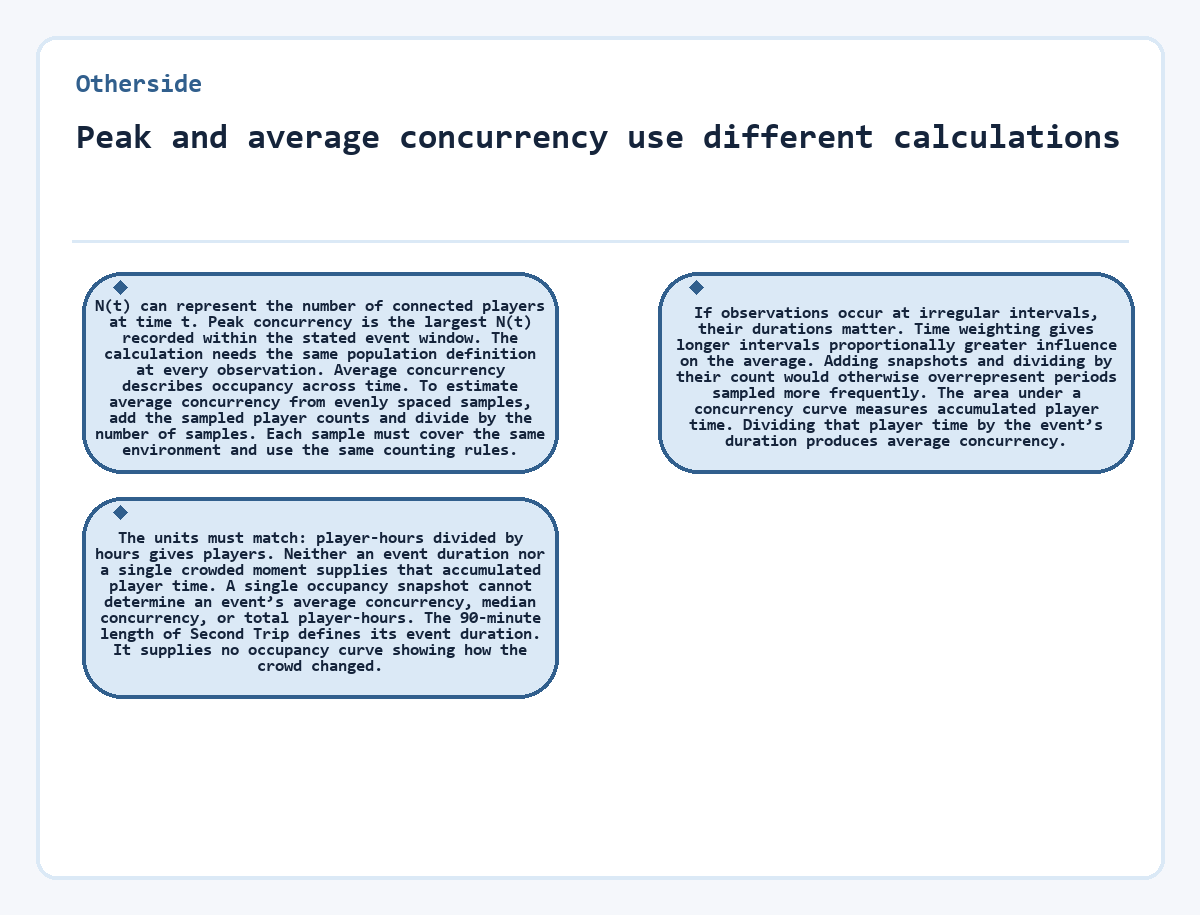
A single occupancy snapshot cannot determine an event’s average concurrency, median concurrency, or total player-hours. The 90-minute length of Second Trip defines its event duration. It supplies no occupancy curve showing how the crowd changed.
Early Trip figures carry different levels of precision
First Trip’s 2022 crowd figure was nearly 5,000 concurrent users, so its limited precision matters when making comparisons. Second Trip hosted 7,214 concurrent users on March 25, 2023. That figure describes concurrent users, so it should retain that label. Relabeling it as total unique attendance changes its meaning. Neither figure counts the supply of NFTs or land assets.
An exact percentage increase needs comparable figures covering the same scope. Using 5,000 as an exact first value would erase the qualification and manufacture precision. The later demonstration supported a larger reported crowd, while an exact growth rate would need more precise baselines and matched counting rules. The 7,214-user result also does not state a maximum capacity. Observed participation and a technical limit are different quantities.
Attendance measures describe different kinds of participation
Player totals describe different forms of participation, depending on whom the count includes and the time window it covers. The unit often reads users, which conceals whether a number covers a moment, a full event, or a broadcast.
| Participation measure | What the count describes |
|---|---|
| Concurrent players | Players present simultaneously; a stated peak applies to its specified measurement window. |
| Unique event participants | Distinct participants across an event; repeat visits require deduplication. |
| Session entries | Entries into the experience; reconnecting can add entries without adding distinct participants. |
| Livestream viewers | Broadcast viewers under the platform’s audience definition; viewing does not establish playable attendance. |
Rejoining can restore a session without creating a new unique attendee. Counting session entries as people would inflate attendance when the entries include repeat connections. Likewise, a broadcast audience might include people already inside the event. Adding both counts requires a method for handling overlap; the sum does not automatically describe distinct people.
Live multiplayer systems made the crowd interactive
Yuga Labs developed the Trips with Improbable’s multiplayer technology, with M² supporting the early shared experiences. Avatars supplied player presence, environments provided spaces to explore, and networked interaction connected participants within the experience. A large crowd becomes a multiplayer experience when actions and communication work within the shared world.
Second Trip also used competitive play across new environments. Its teams gave participants shared objectives during the event. Moving between spaces placed another demand on the system beyond initial entry. The participant count alone cannot describe how quickly those transitions happened. Different avatars, interactions, or audio activity can create a different technical test, even when the concurrency count matches.
Admission rules shaped the playable population
Second Trip admitted Otherdeed holders and invited guests under its March 2023 event rules. Holders had priority, with first-come, first-served admission within regional capacity. Once the event began, holders who had not entered could only watch the livestream. Eligibility did not guarantee a place. That difference separates potential attendees from players actually inside the experience. Those rules belonged to that event; they do not establish access requirements for later experiences.
Regional schedules change how event totals combine
Regional server capacity limited admission to Second Trip, so an event-level player count did not reveal available places in each region. A global headline cannot show every participant’s location or the capacity remaining in a separate queue. It also does not identify the number of physical servers.
Apes Come Home on February 29, 2024, used a different schedule: separate regional events for Asia Pacific, Europe, and North America. That format changes how attendance figures can combine. Adding participants across sequential sessions measures an event-wide total, subject to deduplication of repeat attendees. It does not produce a single simultaneous crowd. Only sessions with overlapping time windows contribute to combined concurrency at the same moment.
Microphone activity adds a separate measure of interaction
Voice activity measured another form of participation during Second Trip: participants used their microphones more than 80,000 times over the experience. That count described microphone uses, not 80,000 speakers or simultaneous players. It shows the event included repeated voice interaction alongside crowded gameplay. The figure has an activity unit, while concurrency counts users. Reading them as the same measure would confuse the frequency of an action with the size of a crowd.
Microphone activations alone cannot reveal total speaking time or how many people spoke. A participant could listen without activating a microphone, and speakers could activate their microphones repeatedly. Dividing the activity total by the concurrent player figure would not establish uses per unique attendee. The numerator covers the full event; the denominator describes a simultaneous population. Calculating an average for individual attendees requires the activity count and participant count to cover the same population and reporting window.
Later experience formats changed the comparison
Apes Come Home was a regionally scheduled 2024 activation, explicitly separate from a Third Trip. By August 2025, Bathroom Blitz had introduced an 8v8 third-person shooter built with the Otherside Development Kit. Its match format described the teams in a game, rather than total users across the platform. Those event formats and match structures have different counting boundaries from the early event-wide crowds.
Crowd size alone cannot establish sustained performance
A simultaneous player count establishes population under the event conditions, while performance requires measurements of the responsiveness players experienced. Network latency describes delay in communication. Rendering performance describes how a device draws the experience. Connection stability concerns whether a session stays usable. These properties can differ across participants within the same crowd. The concurrency number contains none of those units, so it cannot support a specific latency or frame-rate claim.
Second Trip’s 90 minutes describe how long the experience ran, without establishing that 7,214 users remained connected throughout. A brief crowded moment and a sustained population have different operational meanings. Neither establishes universal device compatibility. Requirements for a particular test applied to that event and its supported environment. A comparable crowd in a later release could involve different hardware, software, or access conditions.
Scheduled turnout and recurring use have different time windows
Scheduled Trips gathered participants around a specific occasion, concentrating attendance within a narrow window. Recurring use answers a different question: whether participants returned on other days and continued using the world. Daily and monthly active user counts use broader reporting periods, with their own definition of an active user. Retention tracks whether a particular group comes back. None follows automatically from a large event crowd, even when the demonstration supported thousands of simultaneous users.
Comparisons between those Trips and a continuously available experience need equivalent reporting windows. A scheduled crowd can concentrate activity a persistent world distributes across days. Comparing one peak with an entire month of unique logins mixes incompatible measures. A claim about recurring population must cover repeat visits or continued presence in the period it describes.
Otherside questions, answered
Did a wallet with several Otherdeeds count as several Second Trip players?
The 2023 rules allowed one connection per eligible wallet, regardless of how many Otherdeeds it held. NFT holdings and concurrent players therefore represented different quantities.
What happened if a player disconnected during Second Trip?
Second Trip held an admitted player’s place for five minutes after disconnection under its Otherdeed-holder entry rules. After that window, the participant could only watch the livestream. This was a reconnection rule for the March 2023 event.
Could another connection use a wallet already participating in Second Trip?
During Second Trip in March 2023, a second connection using the same wallet or delegated access linked to an Otherdeed already in use disconnected the first connection, which lost its queue place.
Can a First Trip Obelisk piece prove attendance at the 2022 event?
A First Trip Obelisk piece alone does not establish attendance at the 2022 First Trip. Later activations, including Apes Come Home in 2024, also offered eligible Otherdeeds that metadata update. The piece’s name therefore cannot date the holder’s participation.
Is a concurrent player count a blockchain throughput measurement?
Concurrency counts users present simultaneously, while blockchain throughput counts transactions over time. The 7,214-user Second Trip figure cannot establish transactions per second or the number of gameplay actions recorded on a blockchain.
Do 7,214 concurrent users represent 7,214 verified individual people?
A concurrent user figure alone does not establish verified individual identities. Converting connected-user totals into a count of distinct people requires identity and deduplication rules. The event’s reported concurrency should retain its user-based meaning.